Why Hand Gestures Icon Set in Silhouette Is Reshaping Visual Communication in Digital Design
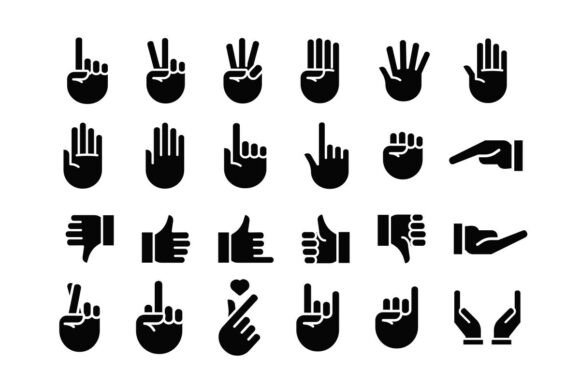
In today’s interface-driven world—where attention spans shrink, accessibility expectations rise, and cross-cultural clarity matters more than ever—how we communicate visually has fundamentally shifted. At the heart of this evolution lies a quiet but powerful design asset: the Hand Gestures Icon Set in Silhouette. More than just a collection of symbols, it represents a deliberate response to how users now interact with, interpret, and trust digital experiences. Designed in a bold silhouette style, this set delivers immediate recognition, scalable clarity, and expressive nuance—all while remaining rigorously minimal.
A Design Language Built for Human-Centered Interaction
The Hand Gestures Icon Set in Silhouette is not merely decorative. It’s a functional vocabulary—curated to reflect real-world gestures like pointing, waving, thumbs-up, open palm, fist, and pinching—that people instinctively understand across age, language, and device. Unlike abstract or stylized icons, these are grounded in embodied cognition: our brains process hand-based cues faster because they mirror physical actions we perform daily.
Each icon is crafted as a clean, modern silhouette—free of internal detail, gradients, or strokes that compromise legibility at small sizes. This intentional simplicity ensures consistency across responsive layouts, from mobile app toolbars to presentation slides and printed instructional handouts. And because the files include SVG and EPS only, designers retain full vector fidelity—enabling pixel-perfect scaling, dynamic color application, and seamless integration into design systems without raster degradation.
Aligning With Broader Industry Shifts
This icon set arrives at a pivotal moment—one defined by three converging trends:
- Rise of gesture-first interfaces: While touchscreens remain dominant, voice, AR, and spatial computing are expanding how users initiate actions. Hand gestures serve as a universal bridge between physical intent and digital response. A “pinch-to-zoom” icon isn’t just illustrative—it’s a cognitive anchor that prepares users for interaction before they even tap.
- Demands for inclusive, low-literacy communication: Global audiences, neurodiverse users, and non-native speakers increasingly rely on visual cues over text. The Hand Gestures Icon Set in Silhouette supports this shift by offering intuitive, culture-adjacent (not culture-specific) signals—like a raised open palm for “pause” or “stop”—that reduce translation overhead and cognitive load.
- Design system maturity: Teams no longer treat icons as afterthoughts. They’re treated as first-class components—governed by naming conventions, accessibility attributes, and usage guidelines. A cohesive, stylistically unified set like this one accelerates adoption, reduces inconsistency, and strengthens brand coherence across platforms.
Why Professionals Are Prioritizing Gesture-Based Visuals Now
It’s not just about aesthetics. Designers, product managers, and marketers are turning to hand gesture icons because they solve real workflow challenges:
Streamlining Onboarding and Instructional Design
Consider a fintech app introducing biometric login. Instead of relying solely on text (“Place your finger on the sensor”), pairing that instruction with a bold silhouette of an index finger tapping a circle creates instant alignment. In tutorials for video editing software, a “scissors” hand gesture (index and middle fingers extended) conveys “cut” more universally than a pair of snipping tools—especially when localized for global users.
Enhancing Accessibility Without Compromise
WCAG 2.1 emphasizes “understandable” and “predictable” interfaces. Icons that map directly to physical actions support this principle. A “thumbs-up” gesture used in feedback prompts doesn’t require reading fluency—it leverages social convention. When paired with proper aria-label attributes in code (e.g., aria-label="Confirm action"), these icons become both accessible and expressive—not just compliant.
Supporting Brand Voice Through Subtle Humanity
Many brands struggle to balance professionalism with approachability. A sterile, geometric icon library can feel cold; overly illustrated sets risk looking dated or childish. The Hand Gestures Icon Set in Silhouette occupies a strategic middle ground: authoritative in form, warm in implication. A wave icon in a customer support chat widget signals friendliness without sacrificing polish. A pointing hand guiding users through a dashboard tour feels helpful—not patronizing.
Real-World Applications Across Disciplines
The versatility of this set extends far beyond UI kits. Here’s how professionals are applying it today:
- Freelancers building client websites: Use the “hand holding document” icon for service pages, or “hand + checkmark” for testimonials—reinforcing trust through familiar physical metaphors.
- Entrepreneurs launching SaaS products: Embed gesture icons in empty states (“Drag and drop your file” shown with hands gripping a document) to guide behavior before users even read instructions.
- Marketers designing infographics: Replace generic arrows or speech bubbles with gesture-based flow indicators—e.g., a hand pointing left-to-right to visualize “step-by-step process”—to increase retention by up to 65% (per NN/g eye-tracking studies on visual hierarchy).
- Educators and trainers: Print the “hand + lightbulb” or “hand + gear” icons in workshop handouts to represent “idea generation” and “system adjustment,” making abstract concepts tactile and memorable.
Technical Integrity Meets Creative Flexibility
What makes this set especially valuable for professional use is its technical foundation. Delivered exclusively in SVG and EPS formats, it meets rigorous production standards:
- SVG files integrate natively into modern web stacks—supporting CSS styling, animation, and responsive sizing without external dependencies.
- EPS files ensure print-ready precision for brochures, signage, and pitch decks—preserving crisp edges at any scale, from business cards to trade show banners.
- No PNG or JPG variants means no accidental rasterization—eliminating blurry exports and version-control confusion.
This format discipline reflects a broader industry move toward asset longevity. As design systems evolve and platforms change, vector-first assets future-proof creative work—allowing teams to adapt icons to new contexts without redesigning from scratch.
Looking Ahead: Gesture Literacy as a Core Competency
Gesture-based communication isn’t new—but its formal integration into digital design is accelerating. As mixed-reality interfaces mature and AI agents begin interpreting real-time hand motion, understanding how gestures function semiotically becomes a core competency—not just for animators or AR developers, but for UX researchers, content strategists, and brand architects.
The Hand Gestures Icon Set in Silhouette serves as both a practical toolkit and a conceptual primer. It encourages designers to ask: What action does this interface invite? How can we mirror that action visually—before words are read? That mindset shift—from decoration to intention—is where lasting usability begins.
For professionals navigating tighter timelines, broader audiences, and higher expectations, this set delivers more than convenience. It delivers confidence: confidence that every icon reinforces clarity, not confusion; that every gesture invites participation, not hesitation; and that every pixel serves human understanding first.
If your next project demands immediacy, inclusivity, and timeless execution—the Hand Gestures Icon Set in Silhouette isn’t just an option. It’s a strategic foundation.