Man Playing Drum Near Mosque Vector: A Strategic Asset for Purpose-Driven Visual Communication
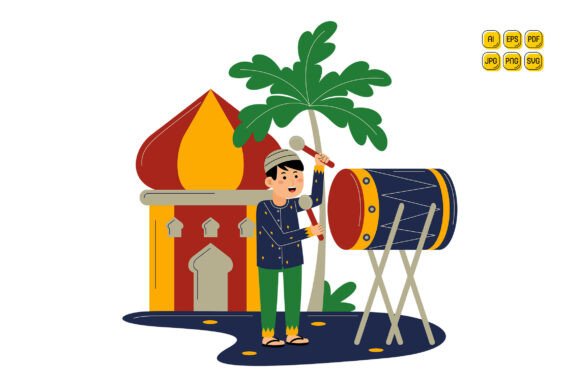
Visual assets are rarely neutral. They carry tone, context, and cultural resonance—especially when they combine symbolic architecture with human action. The Man Playing Drum Near Mosque Vector is more than a stylized illustration; it’s a flexible, culturally grounded visual anchor that supports intentional communication across diverse professional contexts. Its flat design, layered vector structure, and high-resolution output make it unusually adaptable—not just for aesthetics, but for strategy.
Why This Vector Illustration Fits Real-World Planning and Positioning
When you choose an illustration, you’re choosing a frame of reference. The Man Playing Drum Near Mosque Vector evokes rhythm, community, reverence, and presence—all without words. That makes it valuable for organizations and creators whose work intersects with cultural identity, interfaith dialogue, local celebration, education, or civic engagement. Unlike generic crowd or building vectors, this asset carries specific emotional and spatial meaning: the mosque as a fixed point of orientation; the drummer as active, embodied expression nearby—not inside, not distant, but relationally close.
This isn’t decorative filler. It’s a decision point. Using it signals awareness of context. For example, a nonprofit launching a Ramadan literacy campaign might use the vector on a landing page—not to depict religious practice, but to visually affirm familiarity, dignity, and cultural continuity. A city tourism board could integrate it into an infographic about neighborhood festivals, anchoring data with human-scale warmth. In both cases, the vector supports clarity—not confusion—because its symbolism is coherent and respectful.
Strategic Flexibility Starts With File Structure
You’ll receive 100 curated vector illustrations—including the Man Playing Drum Near Mosque Vector—in AI, EPS, SVG, PDF, JPG, and PNG formats, all at 5000 × 5000 pixels. That resolution ensures crisp display on digital billboards, printed banners, or mobile thumbnails. But the real strategic advantage lies in editability: every shape is individually selectable. You can mute the drum’s color to de-emphasize sound, shift the mosque’s hue to match brand guidelines, or isolate the figure for use in an animated social post.
This level of control matters because consistency compounds over time. A small business owner building a seasonal campaign around Eid or Mawlid doesn’t need to commission new art each year—they can reuse and recolor the same vector, adjusting only what serves the current message. That saves budget, reduces production friction, and strengthens visual recognition across touchpoints.
Where Intentional Use Creates Outcomes
Consider three grounded applications:
- Branding refinement: A faith-based counseling service uses the Man Playing Drum Near Mosque Vector on its website header—not as literal representation, but as a subtle visual metaphor for “presence amid tradition.” They desaturate the background, highlight the drummer’s posture, and overlay clean typography. The result feels grounded, calm, and culturally literate—without relying on clichés or stock imagery.
- Infographic storytelling: An educator designing a lesson on Islamic contributions to music history places the vector beside timelines and quotes. Because the SVG format scales infinitely, they embed it directly into an interactive web module—no pixelation, no rework. The illustration becomes a visual footnote, reinforcing narrative rather than distracting from it.
- Social media cohesion: A community radio station runs a month-long series on local percussion traditions. Each week, they post a variation: same vector, different drum texture (added via Illustrator layer), new accent color matching that week’s featured artist, consistent font treatment. Followers begin recognizing the motif—not as repetition, but as continuity.
What to Consider Before You Customize
Adaptability doesn’t equal universality. The Man Playing Drum Near Mosque Vector works best when its use aligns with audience expectations, cultural nuance, and communicative intent. Ask yourself:
- Is the symbolism legible—or potentially ambiguous—to your primary audience? A global tech firm using it in a diversity report may unintentionally narrow interpretation if no contextual framing accompanies it. Pairing it with clear captions or explanatory text mitigates risk.
- Does the visual hierarchy support your goal? If your aim is to highlight data, don’t let the mosque’s architectural detail compete with chart labels. Use layer visibility or masking to simplify during export.
- Are you editing for consistency—or diluting meaning? Changing the drummer’s attire, pose, or instrument risks misrepresentation. Respect the original composition’s integrity unless you have subject-matter guidance or lived experience to inform adaptation.
Thoughtless customization—like arbitrarily recoloring sacred architecture or flattening gesture into caricature—undermines trust. Intentional customization builds it.
Long-Term Value Beyond the First Download
The 100-vector bundle isn’t just volume—it’s optionality with discipline. You’re not buying images; you’re acquiring a visual vocabulary. Over time, you’ll notice patterns: recurring motifs (archways, calligraphic flourishes, rhythmic lines) that can be combined across projects. That’s where true efficiency emerges—not in speed alone, but in coherence. A freelancer who uses the Man Playing Drum Near Mosque Vector for a client’s brochure, then reuses its drum icon as a bullet point in a presentation, then extracts its dome silhouette for a favicon, builds recognizable authorship across outputs.
That kind of reuse also informs better decisions. When you know a vector works across print, web, and motion, you stop treating platforms as silos. You plan campaigns holistically—designing once, deploying thoughtfully.
Productivity Gains That Aren’t About Speed Alone
Yes, the Man Playing Drum Near Mosque Vector saves time. But its deeper productivity value lies in reducing cognitive load. Instead of searching for “mosque clipart” or debating whether a photo feels authentic enough, you open Illustrator, select the vector, adjust two colors, and move forward. That mental bandwidth gets redirected toward messaging, audience analysis, or testing variations—not sourcing.
For educators preparing materials under tight deadlines, for marketers aligning visuals with campaign KPIs, for small business owners managing their own branding—the vector removes one variable so you can focus on what matters most: clarity of purpose.
Final Thought: Design Is Decision-Making Made Visible
The Man Playing Drum Near Mosque Vector earns its place in your toolkit not because it’s versatile in the abstract—but because it invites thoughtful application. It works when matched with intention, edited with respect, and deployed alongside strategy. Whether you’re illustrating a community initiative, refining a brand’s visual language, or building educational resources, its value multiplies when used as part of a larger system—not as a standalone fix. Start with why you need it, not just how it looks. Then customize—not randomly, but deliberately. That’s how visual assets become strategic assets.