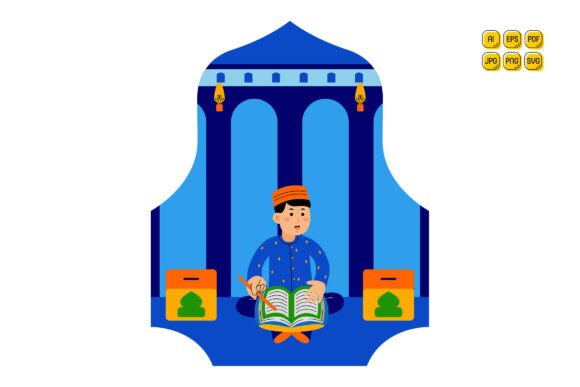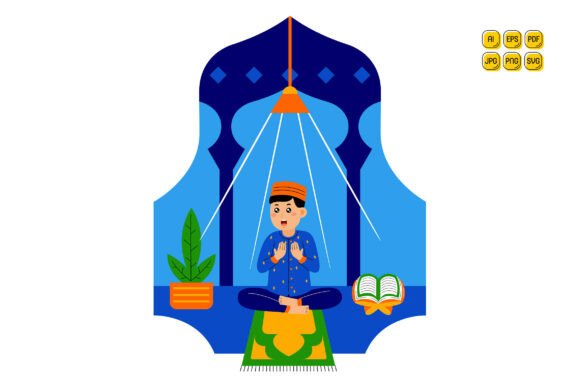
Man Praying on Prayer Mat with Quran
A well-crafted Man Praying on Prayer Mat with Quran vector illustration isn’t just a static image—it’s a flexible, production-ready asset designed for real-world application across creative and professional workflows. Whether you’re building a faith-based brand identity, designing educational materials for Islamic studies, or launching a wellness campaign rooted in spiritual mindfulness, this illustration serves as both visual anchor and functional tool. Its strength lies not in decoration alone, but in how seamlessly it integrates into planning, execution, and refinement stages of your work.
Where This Illustration Fits in Your Workflow
Think of the Man Praying on Prayer Mat with Quran as a modular component—not a final deliverable, but a foundational element you bring in at strategic points. Before a project begins, it helps define tone and intention: marketers use it to align visual language with audience values; educators embed it early when storyboarding lesson plans about spirituality or cultural practice; app developers preview UI layouts using it as placeholder art that already carries contextual meaning.
During active development, it supports consistency and speed. Because it comes in AI, EPS, SVG, PDF, JPG, and PNG formats—including a 5000 × 5000 px high-resolution version—you can drop it into Adobe Illustrator for precise color adjustments, scale it without loss for responsive web banners, or extract individual shapes (prayer mat, hands, Quran cover) to remix into custom infographics. No reworking from scratch. No licensing ambiguity. Just editable, purpose-built geometry.
After launch, it continues to add value. A blogger repurposes the same base file across multiple posts—changing background colors for seasonal themes, swapping out the Quran’s decorative motif for regional calligraphy variants, or layering subtle gradients for social media carousels. Small business owners update landing pages quarterly by adjusting palette and layout—keeping messaging fresh while maintaining brand recognition through consistent iconography.
Integration Across Tools and Platforms
This set works where your tools do. In Adobe Illustrator, the layered AI and EPS files let you isolate and recolor each shape independently—ideal for creating branded variations across departments or campaigns. SVG compatibility means direct embedding in HTML/CSS projects, enabling dynamic theming via CSS variables or JavaScript-driven color shifts. For non-designers, the included PDF and high-res JPG/PNG files plug smoothly into Canva, Figma, WordPress page builders, or email marketing platforms like Mailchimp—no conversion needed.
It also complements other assets intelligently. Pair it with Arabic typography kits for authentic bilingual layouts. Combine it with flat-design mosque silhouettes or crescent motifs (from your existing library or stock sources) to build cohesive scene illustrations. Use the transparent PNG version over gradient backgrounds in presentation decks, or layer it behind animated text overlays in explainer videos exported from After Effects.
Practical Implementation Tips
- Start with intent, not aesthetics. Ask: Is this for awareness (social banner), education (infographic), or reflection (printable journal page)? That determines which format and customization path makes sense first.
- Leverage color psychology deliberately. The prayer mat and Quran are separate vector shapes—so you can assign calming blues for mental wellness content, warm golds for celebration-themed promotions, or muted earth tones for sustainability-aligned initiatives—all without altering structural integrity.
- Batch-edit for efficiency. If you need five versions for a Ramadan campaign (e.g., different background colors + varied Quran cover patterns), edit one AI file, duplicate layers, and swap fills—then export all at once. Saves time versus recreating each from scratch.
- Test scalability early. At 5000 × 5000 px, the file handles everything from billboards to favicon-sized previews—but verify legibility of small details (like Quranic script outlines) at your smallest intended size before finalizing.
- Preserve source integrity. Keep the original AI file untouched. Save edited versions with descriptive names (e.g., “man-praying-blue-bg-illustrator.ai”) so future iterations stay organized and reversible.
Quality Control and Long-Term Usability
Flat design style ensures clarity at any scale—and avoids dated textures or shadows that limit reuse. Each of the 100 included vector illustrations follows the same clean construction logic: grouped paths, named layers, no embedded raster elements. That means no surprises when opening in newer Illustrator versions or exporting to web formats. It also supports accessibility: SVG exports can include ARIA labels for screen readers when used in digital contexts, and high-contrast color variants improve readability for diverse audiences.
Compatibility isn’t theoretical—it’s verified. The EPS file renders reliably in legacy print workflows; SVG passes W3C validation; PDF preserves vector fidelity for client handoffs; and the transparent PNG eliminates background cleanup in fast-turnaround social posts. You’re not choosing between quality and convenience—you get both, out of the box.
Real-World Use Cases Across Roles
Freelancers use the set to build proposal mockups showing clients exactly how their brand will appear across touchpoints—landing page headers, Instagram story templates, printable devotion cards—without waiting for custom illustration quotes.
Educators integrate the illustration into interactive PDF worksheets: students drag-and-drop labeled parts of the prayer posture, or match Quranic verses to corresponding visual cues—all built from the same scalable source.
Bloggers and content creators maintain visual rhythm across long-form articles by inserting consistent, thematically resonant scenes—e.g., a simplified version as a section divider, full-color variant for featured image, monochrome outline for sidebar icons.
Small business owners extend brand equity beyond logos: using the prayer mat shape as a repeating pattern in packaging, adapting the Quran’s spine design into a custom font underline, or animating the man’s posture subtly for an “about us” video intro.
Making Customization Sustainable
Easy editing doesn’t mean arbitrary changes—it means intentional ones. Since every shape is independent, you control hierarchy: emphasize the Quran during literacy campaigns, highlight posture alignment for physical wellness content, or simplify to silhouette-only for minimalist branding. And because all files share the same coordinate grid and proportional baseline, mixing elements across illustrations (e.g., placing the praying man from one scene onto a mosque courtyard from another) feels natural—not forced.
There’s no learning curve baked into the asset itself. What matters is how you map its flexibility to your process: preparing assets ahead of deadlines, standardizing color palettes across teams, versioning for seasonal relevance, or archiving variants for audit trails. That’s where true efficiency lives—not in the file, but in how it fits your rhythm.
Happy designing. Happy purchasing. And most importantly—happy implementing, with clarity, control, and confidence at every stage.