Laboratory Equipment and Science Vector: A Practical Design Asset for Modern Science Communication
Whether you're designing a university lecture slide, launching a biotech startup website, or creating an engaging infographic for a science outreach program, visual clarity matters. The Laboratory Equipment and Science Vector is more than just artwork—it’s a versatile, purpose-built design tool that bridges scientific accuracy with modern visual communication.
What Is the Laboratory Equipment and Science Vector?
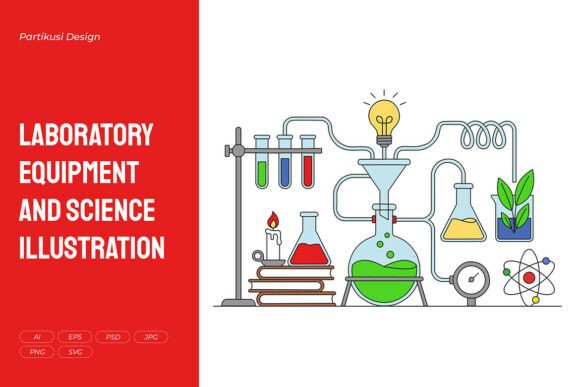
At its core, the Laboratory Equipment and Science Vector is a clean, flat-style illustration crafted entirely in vector format. It features a balanced, thoughtfully arranged composition of recognizable science elements: conical flasks, graduated cylinders, test tubes with colored liquids, precision pipettes, microscopes, digital thermometers, and even symbolic touches like a glowing light bulb—representing innovation and discovery. Unlike photorealistic or cluttered stock imagery, this illustration prioritizes legibility, scalability, and adaptability without sacrificing authenticity.
Because it's built as a vector—not a raster image—it remains razor-sharp at any size: whether scaled to fit a mobile app icon or blown up across a 10-foot conference banner.
Why This Design Style Works for Real-World Projects
The flat, minimalist aesthetic isn’t just trendy—it serves functional needs. In educational materials, for instance, students process information faster when visuals are uncluttered and conceptually focused. A teacher using this vector in a biology presentation can highlight molecular structures beside lab tools without visual competition. Similarly, a research grant application benefits from professional, trustworthy visuals—no pixelation, no licensing ambiguity, and no need to hunt for compatible assets.
This isn’t clip art. It’s a designed system: each element is proportionally accurate enough to read as “lab equipment,” yet stylized enough to feel cohesive and contemporary. That balance makes it effective across diverse contexts—from classroom handouts to investor pitch decks.
Key Features That Set It Apart
- Fully layered vector files (AI, EPS, SVG) allow individual elements—like a beaker or DNA helix—to be selected, recolored, resized, or hidden without affecting others.
- Cross-format compatibility: Includes PSD for designers who prefer layer-based editing in Photoshop, PNG and JPG for quick web use, and SVG for responsive web development.
- Intentional negative space: The layout leaves room for text overlays, logos, or data callouts—ideal for infographics and dashboard visuals.
- Color-flexible palette: Built using editable swatches, so shifting from cool blues (for clinical trust) to vibrant teals (for edtech energy) takes seconds—not hours.
- No placeholder textures or generic gradients: Every surface, shadow, and reflection is purpose-drawn—supporting realism without compromising simplicity.
Who Benefits—and How
The Laboratory Equipment and Science Vector serves multiple audiences—not just designers, but the people who rely on their work:
Educators & Curriculum Developers
A middle school science coordinator can drop the vector into Canva or Google Slides, swap flask colors to match lesson themes (e.g., red for chemical reactions, green for environmental science), and print crisp handouts—even on budget printers. No need to license separate icons or worry about inconsistent styles across slides.
Researchers & Academic Institutions
Grant writers, lab managers, and department communicators often juggle tight deadlines and strict branding guidelines. With editable layers and scalable vectors, they maintain institutional color schemes while adding visual authority to proposals, annual reports, or public-facing web pages.
Tech Startups & Health Innovators
Imagine a diagnostics startup explaining its AI-powered pathology platform. Using the Laboratory Equipment and Science Vector, they can juxtapose a microscope icon with a subtle circuit pattern—visually linking traditional lab work with cutting-edge computation. That kind of storytelling builds credibility quickly.
Marketing Teams & Content Creators
Bloggers covering science literacy, podcasters launching a STEM newsletter, or agencies building campaign assets all benefit from ready-to-use, on-brand visuals. Instead of commissioning custom illustrations for every post, teams reuse and remix one high-quality source—saving time and budget.
Practical Considerations: Strengths and Realistic Expectations
While powerful, it’s important to understand what this asset does—and doesn’t—do.
Strengths:
- Exceptional scalability: Use it on business cards or billboards with zero quality loss.
- Fast customization: Change colors, isolate objects, or export single elements in seconds.
- Consistent tone: Avoids the disjointed look of mixing free icons from different sources.
- Science-adjacent symbolism: The included light bulb, atom motif, and abstract waveform subtly reinforce themes of insight, discovery, and data—without needing text explanations.
Considerations:
- It’s not animated—so if your project requires motion graphics, plan for simple After Effects or Lottie integration separately.
- It doesn’t include photorealistic textures (e.g., glass refraction or liquid viscosity details), which may matter for highly technical simulation visuals—but that’s intentional. Flat style supports speed, clarity, and broad usability.
- While inclusive in representation (e.g., gender-neutral lab silhouettes where present), it focuses on equipment—not people. For human-centered narratives, pair it with complementary photography or illustrated figures.
Real-World Applications You Can Implement Today
- Educational Infographics: Combine test tube icons with percentage labels to visualize lab success rates or experiment outcomes—ideal for science fair displays or district-wide STEM reports.
- Website Hero Sections: Place the vector behind bold headline text on a university research portal, adjusting opacity for readability while keeping the science theme instantly recognizable.
- Startup Pitch Decks: Use the light bulb + flask combo on a “Our Innovation” slide to visually anchor your value proposition—then animate the bulb glow in PowerPoint or Keynote for emphasis.
- Social Media Carousels: Export individual elements as PNGs and build step-by-step stories: “Step 1: Sample Collection → Step 2: Analysis → Step 3: Insight.”
- Printed Lab Safety Guides: Add custom annotations directly in Illustrator—arrow pointers, numbered steps, hazard symbols—all layered cleanly over the base illustration.
How to Evaluate If It Fits Your Needs
Ask yourself three questions before downloading or purchasing:
- Do I need flexibility—or just a static image? If you’ll adjust colors, crop sections, or integrate with other vector assets, the AI/EPS/SVG files are essential. If you only need web-ready PNGs, confirm resolution options meet your platform’s specs (e.g., 2x for retina displays).
- Is consistency across my brand or project critical? If you’re producing multiple related materials (a workshop series, quarterly reports, or a course curriculum), having one cohesive visual language saves enormous time versus sourcing disparate assets.
- Does my audience respond better to clarity or realism? General audiences, younger learners, and international users often grasp flat, symbolic visuals faster than detailed photos—especially when paired with concise text.
In short, the Laboratory Equipment and Science Vector earns its place not because it’s “pretty,” but because it solves real problems: communication friction, production delays, and visual inconsistency—especially where science, education, and innovation intersect.
When your goal is to make complex ideas accessible—not just illustrate them—the right vector doesn’t decorate. It clarifies.