20 Tuning Fork Silhouette Clipart Set: A Versatile Visual Resource for Science, Sound, and Design
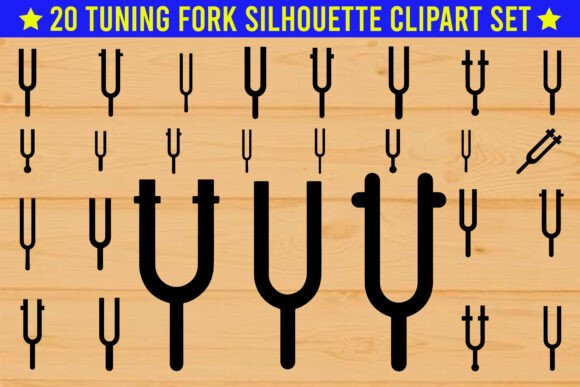
Visual clarity matters—especially when communicating abstract or technical concepts. The 20 Tuning Fork Silhouette Clipart Set bridges precision and practicality by delivering a curated collection of universally recognizable tuning fork icons in clean, high-fidelity silhouette form. Unlike generic clipart libraries that offer one or two repetitive designs, this set provides deliberate visual diversity: 20 distinct configurations spanning prong geometry, angular orientation, proportional scaling, and structural emphasis—all unified by bold, legible outlines and consistent stylistic restraint.
Why Tuning Forks—and Why Silhouettes?
Tuning forks occupy a rare intersection of scientific utility and symbolic resonance. In physics classrooms, they demonstrate harmonic vibration, resonance frequency, and wave propagation. In clinical audiology, they’re diagnostic tools for hearing assessment (e.g., Rinne and Weber tests). In sound therapy and wellness practices, they represent intentional frequency application—often tied to concepts like brainwave entrainment or somatic resonance. Even in branding, the tuning fork evokes alignment, calibration, and harmony.
Silhouette treatment amplifies this versatility. By removing internal detail and color variation, silhouettes prioritize shape recognition over realism—making them instantly legible at small sizes, adaptable across backgrounds, and highly compatible with typography-driven layouts. They function equally well as standalone icons, infographic elements, worksheet illustrations, or layered compositional anchors. The 20 Tuning Fork Silhouette Clipart Set leverages this principle without sacrificing nuance: each of the 20 designs offers subtle but meaningful differentiation—not just rotation or scaling, but thoughtful variations in tine length ratios, base curvature, stem thickness, and fork angle divergence.
File Formats That Support Real-World Workflows
A robust clipart set must adapt to how people actually work—not just what formats exist on paper. The 20 Tuning Fork Silhouette Clipart Set delivers six native file types, each serving a concrete purpose:
- SVG files enable seamless integration into web interfaces, interactive e-learning modules, and responsive educational platforms. Because they scale infinitely without pixelation, they’re ideal for dynamic dashboards displaying acoustic data or frequency comparisons.
- EPS and AI files support deep editing in professional vector environments. Educators can isolate individual prongs to annotate nodes and antinodes; audiologists might layer spectral overlays directly onto fork silhouettes; designers can adjust stroke weight to match brand guidelines before exporting for print or UI use.
- PNG files (with transparent backgrounds) are ready for immediate insertion into slide decks, worksheets, digital flashcards, or social media visuals—no background removal needed. Their high resolution ensures crisp output even in large-format posters used in university labs or clinic waiting areas.
- JPG files provide reliable color fidelity and broad compatibility with legacy publishing software, LMS platforms, and print-on-demand services—critical for educators distributing physical handouts or researchers preparing conference materials.
- PDF files serve dual roles: quick previewing without specialized software, and print-ready output with embedded fonts and vector preservation—ideal for teachers printing classroom posters or therapists creating patient education brochures.
This multi-format strategy reflects an understanding that users aren’t monolithic. A physics lecturer building a lecture video may rely on SVG animation; a music therapist designing a session handout may drop PNGs into Canva; a textbook publisher’s prepress team will need EPS for CMYK separation. The 20 Tuning Fork Silhouette Clipart Set anticipates those divergent needs without requiring conversion steps or quality compromises.
Music Education and Theory
In music pedagogy, tuning forks ground abstract pitch concepts in tangible reference points. Rather than using generic “note” icons, instructors incorporate these silhouettes into chord progression charts, intonation exercises, or historical timelines of tuning standards (e.g., A=440 Hz vs. A=432 Hz debates). One design might illustrate a fork vibrating in air versus submerged—supporting discussions about medium-dependent wave speed. Another could be scaled to represent relative frequencies (e.g., C4 vs. C5), reinforcing logarithmic pitch relationships visually.
Physics Instruction and Visualization
Vibration modes, standing waves, and damping effects become more accessible when paired with accurate, scalable imagery. The 20 Tuning Fork Silhouette Clipart Set includes forks oriented horizontally and vertically—allowing clear depiction of transverse versus longitudinal motion contexts. Some variants emphasize stem flexibility, others highlight symmetrical tine displacement—enabling precise labeling of displacement nodes, pressure antinodes, or energy transfer pathways. These aren’t decorative flourishes; they’re teaching aids calibrated to curriculum-aligned learning objectives.
Audiology and Clinical Communication
Clinical clarity demands unambiguous visuals. When explaining air conduction versus bone conduction pathways to patients—or illustrating test procedures in multilingual consent forms—standardized, non-distracting icons improve comprehension. The consistent silhouette style avoids cultural or stylistic assumptions while maintaining medical credibility. Therapists also use these graphics to co-create visual journals with clients, mapping subjective sound experiences onto objective references—turning abstract sensations into shareable, discussable artifacts.
Sound Therapy and Wellness Design
Wellness practitioners often blend evidence-informed practice with intuitive symbolism. These silhouettes lend themselves to clean, calming layouts—paired with frequency labels (e.g., 128 Hz for grounding, 512 Hz for focus) or chakra associations—without veering into pseudoscientific clutter. Their minimalist aesthetic supports branding cohesion across websites, meditation apps, and workshop materials, where visual trustworthiness reinforces therapeutic intent.
Digital and Print Branding
For startups in audio tech, acoustic engineering, or biofeedback hardware, tuning fork motifs communicate precision, calibration, and resonance—core brand values. Using editable AI or SVG files, designers can integrate a fork silhouette into logos, app icons, or product schematics while preserving scalability and color consistency. In print, the same assets render flawlessly on business cards, trade show banners, and instructional manuals—eliminating format-switching friction.
Design Integrity and Practical Considerations
Not all silhouette sets deliver equal utility. Some sacrifice recognizability for stylization; others lack sufficient variation to avoid visual repetition across multi-page documents. The 20 Tuning Fork Silhouette Clipart Set avoids both pitfalls through intentional curation: no two forks share identical proportions or orientation combinations. This allows users to establish visual hierarchies—for example, using wider-base forks for foundational concepts and slender-tined versions for advanced applications—without relying on color or annotation alone.
Equally important is technical execution. All files are constructed with clean anchor points, minimal path complexity, and properly closed shapes—ensuring compatibility with laser cutters, CNC routers, or embroidery digitizing software. Educators repurposing these for tactile learning tools (e.g., raised-line diagrams for visually impaired students) benefit from predictable stroke behavior during vector-to-raster conversion.
Color flexibility is another quiet strength. While delivered in black silhouette, every vector file supports effortless recoloring—whether adapting to school district branding guidelines, matching accessibility contrast ratios (e.g., dark-on-light vs. light-on-dark), or aligning with thematic palettes (cool blues for physics, warm ambers for wellness). This isn’t just convenience—it’s inclusive design thinking built into the asset structure.
Who Benefits—and How They Use It Differently
A university physics lab coordinator might batch-import SVGs into LabVIEW to label real-time oscilloscope displays. A Montessori music teacher could print JPGs onto cardstock for sorting activities comparing fork sizes and associated pitches. A startup founder developing a hearing health app may extract PNGs for loading screens and animated transitions. A research team preparing a Nature Communications review on vibroacoustic therapy might embed EPS forks into schematic figures illustrating mechanotransduction pathways. Each use case draws from the same 20-source foundation—but applies it with domain-specific intentionality.
That adaptability stems from respecting constraints: no unnecessary gradients, no embedded raster layers, no proprietary font dependencies. What remains is pure, functional form—ready for science, pedagogy, clinical rigor, or creative reinterpretation. The 20 Tuning Fork Silhouette Clipart Set doesn’t try to be everything; it excels at being exactly what each user needs it to be—when they need it, where they need it, and how they need it.