Smart Tunnel Transit System Silhouette: Designing the Future of Urban Mobility—One Scalable Vector at a Time
In an era where cities are redefining density, sustainability, and connectivity, infrastructure visualization has quietly become a strategic asset—not just for engineers, but for communicators, educators, and brand builders. The Smart Tunnel Transit System Silhouette is more than a design bundle; it’s a visual language built for the convergence of automated mobility, resilient urban planning, and human-centered digital storytelling.
A Visual Toolkit Rooted in Real-World Infrastructure Evolution
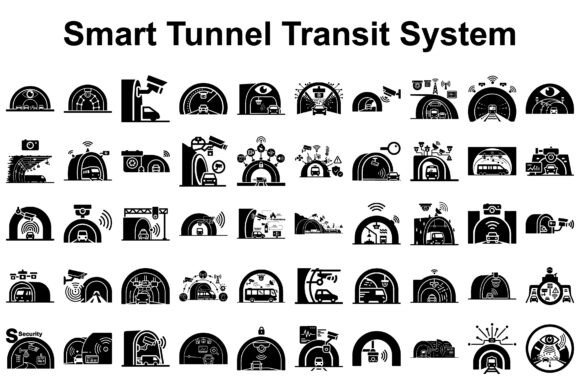
The Smart Tunnel Transit System Silhouette presents a curated collection of 50 distinct tunnel-based transit system silhouettes—each reflecting contemporary advancements in underground transportation: fully automated metro lines, evacuated tube concepts, multi-modal tunnel networks integrating freight and passenger movement, and adaptive infrastructure designed for climate resilience. These aren’t speculative sci-fi renderings. They’re grounded abstractions—clean, confident outlines that distill complex engineering into instantly legible forms.
What makes this set distinctive is its fidelity to both function and form. Each silhouette balances technical plausibility with graphic versatility: tapered tunnel portals suggest aerodynamic efficiency; layered rail alignments imply system hierarchy; integrated sensor nodes and maintenance access points nod to real-world smart infrastructure standards like ISO/IEC 30141 (IoT reference architecture) or EN 15638 (railway asset management). This attention to contextual accuracy transforms the set from decorative clipart into a precision communication tool.
Why Visual Clarity Matters in a Complex Mobility Landscape
Transportation planning no longer happens in isolation. Today’s projects involve cross-disciplinary collaboration—between municipal planners and AI logistics firms, civil engineers and UX researchers, sustainability officers and public engagement teams. In that environment, clarity is not optional—it’s operational. A poorly chosen illustration can misrepresent capacity, obscure scalability, or unintentionally reinforce outdated assumptions about transit hierarchies.
Consider a city commission reviewing a proposal for an automated people mover beneath a historic district. A generic “subway” icon may evoke noise, disruption, or legacy infrastructure—none of which apply to modern low-vibration, silent-drive tunnel systems. In contrast, a precisely rendered Smart Tunnel Transit System Silhouette conveys automation, minimal surface impact, and integration with existing urban fabric—shaping perception before a single slide is presented.
This shift reflects a broader industry evolution: from designing *for* systems to designing *with* them. As cities adopt digital twins, real-time traffic modeling, and predictive maintenance platforms, visual assets must keep pace—not as static decoration, but as interoperable components in data-rich narratives.
Bridging Creative Workflows Across Industries
For designers and marketers, the Smart Tunnel Transit System Silhouette resolves a persistent tension: the need for technically credible imagery without sacrificing creative flexibility. Unlike raster-heavy stock libraries, every silhouette ships in four formats—SVG, PNG, JPG, and EPS—ensuring seamless use across environments:
- SVG files scale infinitely for responsive web dashboards tracking real-time tunnel occupancy or for interactive educational modules explaining geotechnical load distribution;
- PNGs with transparent backgrounds integrate cleanly into presentation decks comparing transit modal share across smart-city pilot programs;
- JPGs deliver high-resolution fidelity for printed reports submitted to funding agencies or regulatory bodies;
- EPS files allow structural engineers or industrial designers to modify alignment geometry or annotate clearance zones directly within CAD-adjacent workflows.
This format diversity isn’t about convenience—it’s about reducing friction between disciplines. When a transport planner shares a schematic with a branding agency, and both can work from the same source file—without conversion loss or licensing ambiguity—the project gains coherence, speed, and shared ownership.
Meeting Evolving Expectations in Education and Public Engagement
Public trust in infrastructure hinges on transparency—and transparency depends on accessible explanation. Students learning about sustainable urban development, community groups reviewing transit equity assessments, or journalists illustrating congestion pricing models all rely on visuals that balance accuracy with approachability.
Traditional transit icons often default to top-down schematics or stylized trains—formats that obscure spatial relationships, depth, or system interconnectivity. The Smart Tunnel Transit System Silhouette offers alternatives: side-profile cuts showing vertical layering of pedestrian walkways, utility conduits, and autonomous shuttles; isometric tunnel junctions demonstrating multimodal transfer points; or simplified longitudinal views highlighting energy recovery braking zones.
These aren’t merely “prettier” graphics—they’re pedagogical tools. A university lecturer using one silhouette to explain tunnel boring machine (TBM) advance rates alongside soil displacement charts creates immediate cognitive alignment. A civic tech nonprofit embedding another into an open-data portal helps residents visualize how new transit corridors reduce last-mile emissions—turning abstract metrics into tangible spatial understanding.
Aligning with Strategic Shifts in Smart-City Development
The rise of the Smart Tunnel Transit System Silhouette mirrors deeper market movements. According to the World Economic Forum’s 2023 Smart Infrastructure Readiness Index, 78% of leading metropolitan authorities now prioritize subterranean mobility expansion—not just for capacity, but for land-use optimization, disaster resilience, and decarbonization. Tunnel-based systems reduce surface-level heat island effects, minimize right-of-way acquisition, and enable 24/7 operations unaffected by weather—a critical advantage as extreme climate events disrupt above-ground networks.
Simultaneously, procurement practices are shifting. Cities increasingly mandate open-data compliance, vendor-agnostic interoperability, and lifecycle visualization—from design through decommissioning. Illustrations that reflect modular construction methods, plug-and-play signaling interfaces, or embedded IoT sensor placement aren’t decorative flourishes; they signal alignment with these operational expectations.
Entrepreneurs building SaaS platforms for infrastructure asset management, freelancers developing AR wayfinding apps for underground stations, or marketing teams launching EV-charging tunnel networks—all benefit from visual assets that speak the same technical dialect as their target stakeholders.
Design Integrity Meets Practical Utility
At its core, the Smart Tunnel Transit System Silhouette represents a quiet but significant recalibration in creative resource development: moving away from generic abstraction toward purpose-built specificity. Its value isn’t measured in quantity—though 50 unique variants offer meaningful variety—but in contextual resonance.
Each silhouette avoids over-design: no gratuitous gradients, no forced perspective distortions, no ambiguous scale cues. Instead, consistent line weights, calibrated proportions, and intentional negative space ensure readability at 12-pixel UI icons and 12-foot exhibition banners alike. That consistency builds visual trust—readers subconsciously register coherence as professionalism.
And because every file is delivered in production-ready formats, users avoid common pitfalls: pixelated exports, mismatched color profiles, or vector flattening that breaks editable layers. For time-constrained professionals—whether pitching a $2B transit bond initiative or finalizing a grant application for equitable mobility access—this reliability translates directly into credibility and efficiency.
Looking Ahead: Where Visualization Meets Infrastructure Ambition
As autonomous tunneling advances, battery-electric TBMs enter commercial deployment, and cities accelerate net-zero transit commitments, the demand for precise, adaptable, and ethically grounded visual language will only grow. The Smart Tunnel Transit System Silhouette doesn’t attempt to predict every future configuration—but it provides the foundational grammar needed to describe them clearly, confidently, and collaboratively.
It serves creators who understand that in today’s infrastructure economy, how we represent systems matters as much as how we engineer them. Whether you’re mapping next-generation freight corridors, teaching urban systems thinking, or positioning a startup in the mobility-as-a-service ecosystem—the right silhouette isn’t just illustrative. It’s an act of alignment.