Creative Hand-Drawn Vector Arrow
Designers and communicators often face a subtle but persistent challenge: guiding attention without sacrificing authenticity. Clean, geometric arrows work well in technical interfaces—but they can feel sterile in storytelling contexts like educational infographics, brand-led social content, or personal creative journals. That’s where the Creative Hand-Drawn Vector Arrow set stands out—not as a novelty, but as a purpose-built solution for projects that demand both clarity and character.
What It Is—and Why It Matters
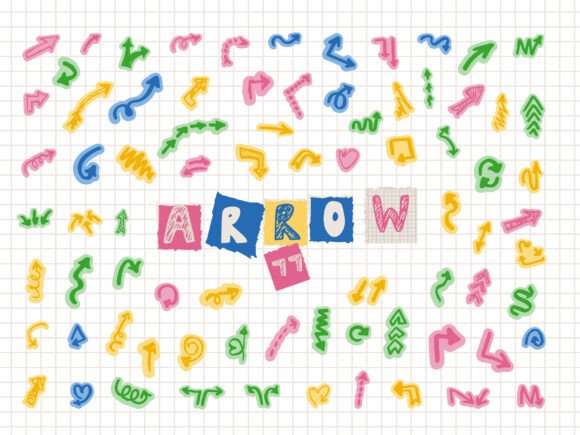
The Creative Hand-Drawn Vector Arrow is a curated collection of dozens of unique, hand-drawn arrow illustrations delivered in a single SVG file. Unlike raster-based doodle packs or isolated vector icons, this set prioritizes cohesion and scalability from the start. Each arrow was drawn by hand—then carefully traced and optimized as vector paths—preserving organic line weight variation, slight asymmetry, and expressive gesture while ensuring pixel-perfect rendering at any size.
This dual nature—handmade aesthetic + vector precision—is what makes it functionally distinct. You’re not just getting decorative elements; you’re getting navigational tools that retain visual warmth whether placed on a 4K presentation slide, a printed workshop handout, or a mobile-first blog layout.
Practical Strengths in Real Use
In practice, the Creative Hand-Drawn Vector Arrow excels where many illustration sets fall short: consistency without rigidity. All arrows share a unified stylistic language—similar ink texture, comparable stroke contrast, and harmonized color palette—but avoid repetition. There are directional arrows (left, right, up, down), looping arrows, branching arrows, curved pointers, “call-out” arrows with tails, and even subtle variants with dotted lines or tapered ends. None feel like duplicates; each serves a specific compositional role.
Because everything lives in one SVG file, opening it in Illustrator, Figma, or Inkscape reveals all arrows as grouped, labeled layers. You can isolate, recolor, resize, or reposition individual arrows without losing fidelity—or export subsets as needed. No hunting through folders for matching files. No mismatched stroke weights across assets. No raster artifacts when zooming in during client presentations.
Who Benefits Most—and How
Freelance designers building pitch decks for creative agencies find these arrows especially useful when illustrating process flows or value propositions—where corporate clip art would undermine credibility, but overly polished icons might feel detached. Educators preparing classroom materials use them to highlight key concepts in lesson slides without triggering visual fatigue. Bloggers and newsletter writers integrate them into explainer graphics to reinforce hierarchy and movement, helping readers follow complex ideas more intuitively.
Small business owners updating their website’s “How It Works” section report faster iteration cycles: instead of commissioning custom illustrations for each step, they adapt existing arrows—changing colors to match brand guidelines, rotating to fit layout constraints, or combining two arrows to imply feedback loops. One UX writer noted using them to annotate wireframes during early-stage stakeholder reviews, finding that the hand-drawn quality signaled “this is exploratory,” reducing premature critique of layout decisions.
Quality and Reliability Considerations
The SVG file has been tested across major design platforms and export workflows. Arrows render cleanly when embedded directly in HTML, exported to PDF for print, or converted to PNG for social media. Stroke alignment remains accurate, even after multiple scaling operations—no pixel drift or unintended path simplification. Colors use standard sRGB values, avoiding unexpected shifts when shared across devices.
That said, users working in highly constrained environments—such as legacy CMS templates with strict SVG sanitization rules—should verify whether embedded metadata or non-standard attributes trigger filtering. A quick open-in-text-editor check confirms the file contains only essential vector markup, no scripts or external references. For teams requiring strict accessibility compliance, note that these are purely decorative illustrations; meaningful navigation cues should still be supported with semantic HTML and ARIA labels where appropriate.
Flexibility Without Compromise
Customization is straightforward but thoughtful. Since all strokes are native vector paths—not brushes or raster effects—you can adjust fill, stroke color, opacity, and even apply subtle gradients or blend modes without degrading quality. Need an arrow that points diagonally at 37°? Rotate it freely. Want to extend its length while preserving natural taper? Scale proportionally along one axis only. The underlying construction supports those edits reliably.
Color usage is another strength. The default palette balances vibrancy and versatility: muted teals, warm ochres, soft corals, and deep indigos. These tones coordinate well with both light and dark backgrounds, and most convert cleanly to grayscale for accessible versions or monochrome printing. Users have successfully shifted the entire set to match brand palettes using global color swatches in Illustrator or CSS variables in web projects—typically in under two minutes.
Limitations Worth Acknowledging
This isn’t a UI component library. You won’t find hover states, animated variants, or interactive logic baked in. It’s also not intended for high-frequency interface elements like pagination controls or carousel indicators—where consistency and predictability outweigh expressive variation. If your project demands dozens of identical, pixel-aligned arrows repeated across hundreds of screens, a parametric icon system may serve better.
Similarly, while the hand-drawn style adds personality, it may not suit contexts requiring strict formality—think regulatory documentation, financial reporting dashboards, or enterprise software toolbars. That’s not a flaw; it’s intentional scope. The Creative Hand-Drawn Vector Arrow targets communication where voice matters as much as direction.
Making It Fit Your Workflow
For designers already using Figma or Adobe XD, importing the SVG and converting to components allows rapid reuse with auto-layout and variant support. In Illustrator, saving a custom symbol library from the file streamlines future access. Developers embedding arrows directly into websites benefit from SVG’s lightweight footprint and CSS-controllable properties—scaling, rotation, and color changes can be managed via classes rather than asset swaps.
A practical tip: pair these arrows with simple sans-serif type (e.g., Inter, Lato, or system fonts) to maintain readability. Avoid pairing with overly decorative or script fonts—the arrows carry enough visual interest on their own. When used in infographics, consider limiting arrow colors to two or three per composition to preserve focus. And if you’re journaling or sketching digitally, try using the arrows as layer masks or clipping paths to guide handwritten annotations.
The Creative Hand-Drawn Vector Arrow doesn’t replace foundational design skills—it supports them. It saves time without constraining expression, offers variety without sacrificing coherence, and delivers polish without erasing personality. Whether you’re mapping a customer journey, designing a workshop activity, or adding narrative flow to a long-form article, it provides a reliable, human-scaled way to say “look here” — and mean it.